


According to the recently published annual results of Fost Plus, Belgian consumers continue to sort their packaging waste exceptionally well. Correct sorting remains a crucial first step in keeping materials in circulation and enabling high-quality recycling.
According to Fost Plus, each Belgian citizen sorted an average of 23.7 kilograms of paper and cardboard packaging in 2025. In addition, an average of 26 kilograms of PMD (Plastic packaging, Metal packaging, and Drink cartons) and 27.7 kilograms of glass were collected per person. Although the volume of paper and cardboard packaging collected decreased slightly compared to the previous year, Belgium remains one of Europe’s leading countries in packaging collection and recycling.
A well-functioning collection and sorting system forms the foundation for recycling and the recovery of valuable materials, and for liquid packaging cartons to meet their full circularity potential.
Fost Plus emphasises that Belgium’s strong performance is largely due to the efforts of consumers. Millions of Belgians sort their packaging every day, often almost automatically. According to Managing Director Francis Huysman, stresses the importance of this individual action: “What we do not collect, we cannot recycle.” Finally, Fost Plus points out that Belgium is already well on track to meet several of the European targets set out in the Packaging and Packaging Waste Regulation (PPWR).
Source: Bijna 6 keer meer plastic verpakkingen in eigen land gerecycleerd dan vier jaar geleden
4evergreen alliance has recently published Version 4 of its Circularity by Design Guideline, a major update to the guidance document that helps companies design paper-based packaging that can be efficiently collected, sorted, and recycled. The new version takes into account the latest requirements of the European Packaging and Packaging Waste Regulation (PPWR) and builds on a year of intensive collaboration among experts from across the entire value chain.
4evergreen alliance is a cross-sector alliance bringing together more than 110 organisations, including forest owners, packaging manufacturers, brand owners, recycling companies, and research institutions. The three members of ACE Belgium, Tetra Pak, SIG Group, and Elopak, are also part of the network.
The Circularity by Design Guideline provides practical recommendations for the design of paper-based packaging and addresses three different recycling routes: conventional paper mills, paper mills with flotation de-inking processes, and specialised recycling processes. Version 4 includes clarified terminology, updated compatibility criteria, and improved guidance to help packaging better align with existing collection, sorting, and recycling systems.
According to 4evergreen alliance, the updated guideline provides companies with a clearer framework for aligning packaging design decisions with future European requirements on circularity and recyclability.
Source: https://4evergreenforum.eu/about/circularity-by-design-guideline/
On 5 and 6 May 2026, the Food and Beverage Carton Alliance (FBCA), the voice of the European beverage carton industry, participated in the Plastics Recycling Show Europe (PRSE) in Amsterdam. This leading trade fair brings together companies, recyclers, policymakers, and technology providers from across the plastics recycling value chain to exchange knowledge on innovation, circularity, and recycling.
During the event, the recycling of PolyAl was in focus – PolyAl is the valuable material composed of the protective barrier layer of liquid packaging carton (polymer and aluminium) that is used as recycled material in a wide range of industrial applications and products.
Several innovative European actors involved in PolyAl recycling and use of recycled materials were present, including Ecorevive, Fych Technologies, Lucart, Palurec, Plastigram Industries, Recon Polymers, Trans Sabater, and Yellow Dreams. The discussions focused on future application developments and renewed commitments to a circular economy.
Sources:
- https://prseventeurope.com/prse2026/en/page/home
- https://aktual.be/conferences/plastics_recycling_show_europe_prse_2026/
- https://recyclinginside.com/events/plastics-recycling-show-europe-prse-2026/
- Meet us at the Plastics Recycling Show Europe 2026 – Stand N65 – Resources – The Food & Beverage Carton Alliance
In light of current discussions around packaging recyclability, the Food and Beverage Carton Alliance (FBCA) developed RECY:CHECK a European, harmonised methodology for objectively assessing the recyclability of fibre-based composite packaging, including food and beverage cartons.
RECY:CHECK was developed with the support of independent industry experts, suppliers, manufacturers, external consultants, and recycling specialists.
The protocol provides a comprehensive certification methodology designed to deliver concrete evidence of recyclability, enables packaging designers to optimise their solutions and give recyclers confidence that the packaging entering their facilities has been designed with recycling in mind. The methodology describes how the recyclability of fibre-based composite packaging can be assessed in specialised recycling facilities that process beverage cartons, including the protective PolyAl fraction, the polymer and aluminium barrier layers that remain after the paper fibres have been recovered and can be further processed.
To explain the methodology in an accessible way, ACE Belgium recently published a video on LinkedIn featuring Raymond De Schrevel, Global Business Development Manager at FBCA and one of the co-developers of RECY:CHECK. In the video, he explains why the methodology was developed and how it supports both manufacturers and recyclers. According to De Schrevel, RECY:CHECK ensures that packaging is assessed in a uniform manner, while giving designers insights into possible improvements and providing recyclers with greater certainty regarding the recyclability of the packaging entering their processes.
Watch the video here:
- NL: https://www.linkedin.com/feed/update/urn:li:activity:7437456044869595136
- FR: https://www.linkedin.com/feed/update/urn:li:activity:7437456068894642176
Source: https://fbcaglobal.com/our-focus-areas/recycheck
On 5 May 2026, the Circular Economy Forum 2026, organised by The Parliament Magazine, brought together European policymakers, regulators, industry representatives, and civil society organisations to discuss the future of the circular economy in Europe. At the heart of the discussions was the proposed Circular Economy Act, a European Commission initiative aimed at creating a more integrated European market for secondary raw materials, reducing regulatory fragmentation, and stimulating investment in circular solutions.
The upcoming Circular Economy Act is a unique opportunity to strengthen the European single market and the competitiveness of European companies. In complement to the Packaging and Packaging Waste Regulation (PPWR), the CEA will shape the system for packaging, recycling, and the use of secondary raw materials.
The beverage carton sector was represented at the forum by Konstantinos Malandrinos, Senior Policy Director for European Affairs at the Food and Beverage Carton Alliance (FBCA). During the panel discussion “Designing for Circularity: What’s Next for Product Lifecycles?” the panel explored how effective policymaking and collaboration can contribute to more circular product lifecycles across Europe. FBCA stressed the importance of looking beyond design for recycling to the entire system: from food safety and material use to collection, sorting, recycling infrastructure, and consumer information to keep materials in circulation.
Overall, it is clear that to invest confidently in circular solutions, businesses require legal certainty, supported by clear legislation, timely implementing measures, and consistent interpretation of the rules.
Sources:
- https://environment.ec.europa.eu/strategy/circular-economy_en
- https://events.theparliamentmagazine.eu/event/circular-economy-forum/
- https://www.europarl.europa.eu/RegData/etudes/BRIE/2026/782628/EPRS_BRI(2026)782628_EN.pdf
- Https://fbcaglobal.com/news-and-resources/news/circular-economy-forum-2026
12 August 2026 will be an important date for the packaging sector, as the new Packaging and Packaging Waste Regulation (PPWR) starts applying across the EU. With this European regulation, the EU aims to reduce packaging waste, limit the use of primary raw materials, and accelerate the transition towards a circular economy.
The food and beverage carton sector is already actively preparing for new requirements, which include measures related to packaging design, technical documentation, producer responsibility, and the way in which the recyclability of packaging is assessed.
Food and beverage cartons already benefit from an established collection and recycling chain in Belgium and Europe. In addition, while work is still ongoing at European level on the technical criteria that will determine how recyclability and Design for Recycling will be assessed in practice, the Food and Beverage Carton Alliance (FBCA) recently published updated Design for Recycling Guidelines for beverage cartons and, together with RECY:CHECK, developed an assessment and certification methodology to objectively evaluate the recyclability of fibre-based composite packaging.
Preparations for the PPWR are also well underway in Belgium. In view of the application of the new rules from 12 August 2026 onwards, the competent authorities and organisations within the extended producer responsibility (EPR) system are preparing for the implementation of the new framework. The Interregional Packaging Commission (IVC) has already informed companies about the impact of the new legislation and the changes that will apply from that date.
Belgium starts from a strong position. Thanks to existing systems such as Fost Plus and Valipac, our country is among the European frontrunners in the collection and recycling of packaging. This accumulated expertise is an important asset in the implementation of the PPWR and provides a solid basis for putting the new European requirements into practice.
Sources:
- https://environment.ec.europa.eu/topics/waste-and-recycling/packaging-waste_en
- https://environment.ec.europa.eu/publications/faq-packaging-and-packaging-waste-regulation-ppwr_en
- https://www.ivcie.be/verordening-betreffende-verpakkingen-en-verpakkingsafval-ppwr-belangrijke-wijziging-voor-verpakkingsverantwoordelijken-vanaf-12-augustus-2026/
- https://www.lw.com/en/insights/european-packaging-and-packaging-waste-regulation-summary-of-provisions-and-new-guidance
- https://www.vbo-feb.be/nl/nieuws/nieuwe-eu-verpakkingsregels-ppwr-impact-vanaf-2026/
- https://www.fostplus.be/nl/ppwr/alles-wat-je-moet-weten-over-de-nieuwe-europese-verpakkingswetgeving
- https://fbcaglobal.com/news-and-resources/news/fdsfds
On 19 and 20 May, the annual PLMA World of Private Label International Trade Show took place at the RAI Convention Centre in Amsterdam. As the world’s largest trade show entirely dedicated to private label products, it brought together more than 3,300 exhibitors from 80 countries. The event provided a unique opportunity for manufacturers and retailers to discover new products, network, and exchange ideas. SIG and Tetra Pak, both members of ACE Belgium, were also present at the show.
Other PLMA Activities
In addition to the trade show, PLMA organised a series of seminars and workshops on 18 May, focusing on the latest developments in the private label market. Topics included sustainability, consumer trends, data, and artificial intelligence.
Sustainability was also a key theme on the exhibition floor. Around 30% of exhibitors were active in the organic, vegan, and plant-based products market, reflecting growing consumer demand for products that are both healthy and sustainable.
Finally, collaboration between retailers and suppliers, as well as changing consumer behaviour, were among the central themes highlighted throughout the event.
Source:
Two out of three consumers would like more information about the recycling process
In April this year, ACE Belgium published a press release presenting the results of a consumer survey conducted on its behalf by an independent research agency among a representative sample of 1,000 Belgians. The survey examined consumers’ perceptions of beverage cartons, their recyclability, and their sustainability.
The results show that Belgian consumers generally have a positive view of beverage cartons, and confirm that consumers care about sustainability. Still, more awareness is needed on recycling, raw materials, and environmental impact.
Overall, consumers are already active actors of the circular economy, with 83.5% saying they always dispose of used beverage cartons correctly in the blue PMD bag. In addition, more than half of the respondents (52.2%) deliberately choose beverage cartons for their sustainability profile and circularity credentials. Nearly two-thirds of Belgians view beverage cartons as recyclable and suitable for processing into new valuable materials after use.
Nevertheless, the survey shows limited awareness about what happens to beverage cartons after they have been collected and sorted, and 65.9% respondents indicated that they do not know what happens to the material after recycling. Several misconceptions also persist regarding sustainability. For example, 43.1% of Belgians believe that recyclability and the use of renewable raw materials are the same thing, while 38.8% think that the production of beverage cartons leads to a reduction in forests. At the same time, consumers are clearly asking for greater transparency: 58% consider it important that information on the CO₂ footprint of packaging be readily available.
For ACE Belgium, the findings underline the importance of objective communication and continued awareness-raising about the circular properties of food and beverage cartons.
The fact sheet of the research report is available at: https://beveragecarton.be/research-march-2026/
Source: https://beveragecarton.be/press-releases/
More than half* of Belgians consciously choose beverage cartons
2 out of 3 consumers want more information about the recycling process
Belgian consumers have a notably positive attitude towards beverage cartons. This is the main conclusion of a consumer survey commissioned by ACE Belgium, the organization representing leading beverage carton manufacturers. Consumers also indicate that they usually sort their beverage cartons correctly, consider them recyclable, and would welcome it if more brands chose them. At the same time, however, nearly two thirds wonder what happens to these packages after collection and sorting. This lack of knowledge leads to doubts about the actual recycling process and, consequently, the environmental impact of beverage cartons. Read the full research report at https://beveragecarton.be/
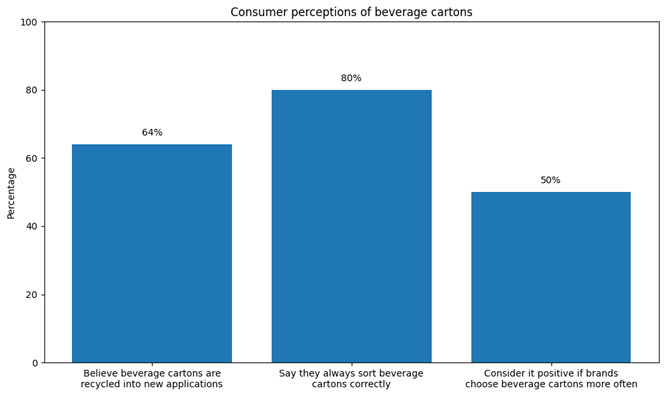
As shown in the chart below, the study commissioned by ACE demonstrates that consumers attach great importance to the recycling of the beverage cartons they use. This is reflected in the high sorting and recycling rate of over 90%.
Chart: Consumer perception of the sorting and recycling of beverage cartons
Misunderstandings due to lack of information
The survey shows that there is a strong need for clear and reliable information. Almost 6 out of 10 consumers (58%) explicitly expect clearer communication about the CO₂ footprint and the sustainability of packaging.
Table: Misconceptions and prejudices about the recycling of beverage cartons
| Misconceptions and prejudices | Percentage |
| Consumers think that beverage cartons are difficult to recycle. | 50% |
| Consumers do not know what happens to beverage cartons after sorting. | 65.9% |
| Consumers believe that beverage cartons are eventually incinerated. | 25% |
| Consumers believe that recyclability and the use of renewable raw materials mean the same thing. | 43.1% |
| Consumers think that forests in our country are disappearing due to the production of beverage cartons. | 38.8% |
| Consumers say that labels such as FSC/PEFC are not very reliable. | 31.7% |
| Consumers say they do not know which type of food and beverage packaging is the most or least sustainable. | 68% |
“As a sector, we support the European legislative initiatives aimed at preventing greenwashing. Transparency is essential to inform consumers correctly and strengthen their trust. That is why we opt for factual communication, supported by independent and third-party validated data such as life-cycle analyses, and we work together with reliable partners throughout the value chain”, says Nathalie Walter, managing director of ACE (Alliance for Beverage Cartons and the Environment), which represents Tetra Pak, SIG Group and Elopak, the three largest producers of beverage cartons in our country.
Ease of use, environmental impact and food safety determine preference
Consumers believe that beverage carton packaging stands out from alternatives because of its ease of use (52.7%), environmental friendliness (44.6%), shelf life (43.9%) and food safety (39.8%). It is noteworthy that the sustainability of beverage cartons is the least credible argument when the sector itself uses it in its communication. More and better reliable information is therefore also needed in this area.
“Sustainability arguments must be based on facts that people can trust. Precisely because sustainability is currently the least credible argument when beverage carton producers highlight it themselves, we must continue investing in better, clearer and objectively substantiated information,” concludes Nathalie Walter.
*This is shown by a survey conducted in mid-January 2026 on behalf of ACE by an independent research agency among a representative sample of 1,000 Belgian consumers, representative in terms of language, gender, age and education. The maximum margin of error among 1,000 Belgians is 3.02%.
—
Press contact
Leen Vandevelde
Tel: +32 471 09 17 24
About ACE Belgium
The Alliance for Beverage Cartons and the Environment in Belgium is an association that brings together the leading manufacturers of beverage cartons for the Belgian and European markets: Tetra Pak, Elopak and SIG Group. Our mission is to contribute to improving and achieving the recycling rate of our packaging and to provide a platform to highlight its environmental benefits. Together with stakeholders from our sector (suppliers, producers, producer organisations, municipalities, recycling companies, etc.), ACE Belgium is committed to setting up concrete actions and developing tangible tools.
More information: https://beveragecarton.be/nl/
Q1: To what extent do you agree or disagree with the following statements about the recycling of beverage cartons?
- More than half (50.5%) of Belgians think that the aluminum and polymer layers make beverage cartons more difficult to recycle than other types of packaging (PET/plastic, metal cans, glass).
- Nearly 1 in 3 Belgians (32.2%) say that recycling information on beverage cartons is mainly marketing and therefore not reliable.
- 65.9% of Belgians have no idea what happens to the recycled material from beverage cartons.
- More than half (52.2%) of Belgians buy beverage cartons because they are recyclable.
- More than 1 in 3 Belgians (42.8%) think that recycling beverage cartons results exclusively in new cardboard packaging for food & beverages.
Q2: To what extent do you agree or disagree with the following statements about sorting beverage cartons?
- 1 in 4 Belgians (25.3%) agree with the statement: “Whether I sort it or not, most beverage cartons are incinerated anyway.”
- More than 8 in 10 Belgians (83.5%) always dispose of their used beverage cartons in the blue bag.
- More than 1 in 3 Belgians (44.5%) say that incorrect sorting by others makes sorting beverage cartons pointless.
Q3: To what extent do you agree or disagree with the following statements about the raw materials used to make beverage cartons?
- 43.1% of Belgians say that beverage cartons being recyclable and being made from a renewable resource mean the same thing.
- More than 1 in 3 Belgians (38.8%) say that the production of beverage cartons leads to fewer trees and forests in our country.
- 31.7% say that labels such as FSC/PEFC, which indicate that the wood fibers used for beverage cartons come from sustainably managed forests, are not very reliable.
- For more than 1 in 3 Belgians (34%), the claim that beverage cartons are recyclable feels like greenwashing.
- 64.6% of Belgians consider beverage cartons sustainable because they are largely made from recycled paper and cardboard.
- More than half (51.8%) would consider it a positive change if a brand switched to beverage cartons.
Q4: To what extent do you agree or disagree with the following statements about the CO₂ footprint of beverage cartons?
- 40.1% of Belgians think that beverage cartons have a higher CO₂ footprint than other types of packaging due to their aluminum and polymer layers.
- More than half (58%) of Belgians find it important that information about the CO₂ footprint is indicated on beverage cartons.
- 42.1% agree with the statement that beverage cartons have a lower CO₂ footprint than other types of packaging because they are lighter and therefore require less energy for transport.
Q5: To what extent do you agree or disagree with the following statements about the sustainability of beverage cartons?
- Nearly half (49.5%) of Belgians disagree with the statement: “I avoid beverage cartons because they are less sustainable than alternative packaging.”
- 68.8% indicate that they have no idea which type of food and beverage packaging (PET/plastic, glass, cans, cartons) is the most or least sustainable.
- 63.7% agree with the statement that beverage cartons are recyclable and, after use, are processed into new valuable materials, such as cardboard boxes and plastic pallets.
Q6: To what extent do you agree or disagree with the following general statements about beverage cartons?
- More than 1 in 3 Belgians (39.8%) consider beverage cartons to be better for food safety than other types of packaging.
- 43.9% believe that beverage cartons preserve their contents better than other types of packaging.
- More than half (52.7%) find beverage cartons more user-friendly than other types of packaging.
- Nearly 7 in 10 Belgians (69.8%) find beverage cartons more convenient to store than other types of packaging.
- According to 44.8%, beverage cartons preserve the quality and taste of their contents better than other types of packaging.
- According to 44.7%, beverage cartons are better for the environment than other types of packaging.
- Opinions are divided when it comes to price: 30.4% say that drinks in beverage cartons are more expensive than the same drinks in other types of packaging, while a similar proportion (30.1%) say they are cheaper.
Q7: How important are the following criteria to you when choosing packaging for food and beverages?
- Price: important for 86.4%
- Brand: important for 52.7%
- Ease of use: important for 85.8%
- Quality of the contents: important for 89.6%
- Shelf life: important for 88.2%
- Food safety: important for 85.2%
- Sustainability: important for 71.3%